



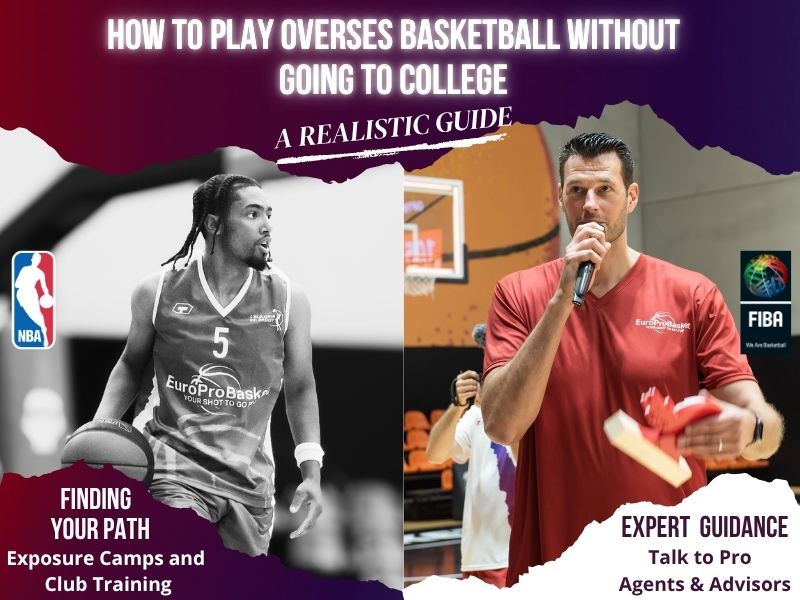
Yes, you can play professional basketball overseas without a college degree. Full stop.
But here’s what most guides won’t tell you: most international teams don’t care about your college credentials — they care about what you can do on the court. The real challenge isn’t whether you can play overseas. It’s whether you have a clear path to get noticed by teams that will pay you to play.
My name is Brad Kanis. I’ve spent over a decade running EuroProBasket at L’Alqueria del Basket — Valencia Basket’s official facility in Valencia, Spain. We’re partnered with Valencia Basket which is one of the most distinguished clubs in the World, currently ranked #2 in all of Europe! Since 2015, we’ve helped hundreds of players sign professional contracts across Europe. Many of them never played NCAA basketball. Some came from junior colleges, NAIA programs, high school, or club ball.
This guide is based on what actually works — not theory.
Full disclosure before we go further: the program I run, the Euro Professional Program, is built for exactly this player — three to twelve weeks in Valencia, training and competing in front of European clubs.
Do You Need College to Play Professional Basketball Overseas?
No. European, Asian, Middle Eastern, and African basketball leagues operate independently from the NCAA. They don’t have eligibility rules tied to college attendance. They don’t verify transcripts. They don’t care if you went to a Division I school or didn’t finish high school.
What they do care about: Can you play? Are you reliable? Can you help the team win?
The catch: without college experience, you lose a built-in scouting platform. College basketball gets watched by scouts automatically — stats are tracked, games are filmed, and visibility is guaranteed. Without that, you need to create your own visibility or find a program that builds it for you.
Why Everyone Thinks College Is Required (And Why That’s Wrong)
This misconception exists because college dominates American basketball media. The NBA pathway is college-heavy. ESPN covers March Madness obsessively. So American players and parents assume college is the only route to professional basketball.
It’s not. Not even close.
In Europe, the professional basketball ecosystem starts at age 16 or 17. Players in Spain, France, Germany, Turkey, Italy, and the Balkans sign professional contracts at 18 or 19. They’re earning money playing basketball before they’re legally allowed to drink in the United States. Their youth academies feed directly into professional clubs — no college in between.
From the perspective of a European team scout, a college transcript is irrelevant. What matters is: Do you have video of yourself playing against real competition? Do your stats back up the film? Do you fit the European style of play?
That’s it.
What Overseas Basketball Scouts Actually Evaluate
When I evaluate a non-college player for a professional contract, here’s my actual decision tree:
Game Film
Video of you playing competitive basketball. I want to see you against opponents who are actually good. Playground dunks don’t count. Neither do highlights against weak teams or disorganized showcase camps.
I want to see you in games where your team is challenged and you rise to that challenge. Can you shoot consistently? Do you handle pressure? Are you coachable? Film answers these questions faster than anything else.
Statistics and Performance Data
If you’re playing in an organized league, your numbers matter. Scoring averages, field goal percentages, assist-to-turnover ratios, rebounding rates — these paint a picture. They don’t guarantee anything, but they matter.
I want to see progression. Did your stats improve year over year? Did you dominate your league? Document everything with context: “17.2 PPG in the XYZ League” means nothing. “17.2 PPG in the XYZ League (top 8 teams in state)” means something.
Physical Tools and Measurables
Height, wingspan, athleticism, speed — these are measurable. If you’re 6’3″ and can touch 11 feet, that’s data a scout can use. If you’re 5’11” with a strong frame and excellent lateral quickness, that’s also useful.
International teams need specific physical profiles for specific positions. Know your measurements. Know your vertical, your 40 time, your wingspan. When a scout asks, answer with specificity — not vague generalities.
Attitude and Professionalism
This is where talented players without college experience often fail. College teaches structure: showing up on time, handling tough coaching, managing your life around basketball.
If you’re applying for a professional contract from outside the college system, you need to prove you’re a professional. Teams will take a slightly less talented player who’s reliable over a more talented player who’s unpredictable. Responsiveness, punctuality, coachability — these aren’t soft skills overseas. They’re requirements.
Alternative Paths to a Pro Contract Without College
If you’re not going the NCAA route, you need a pathway to get on scouts’ radars. Here are the realistic options:
Professional Basketball Academies in Europe
In Europe, academies are training centers affiliated with professional clubs or independent organizations. Some of the best academies in Spain, France, and Germany actively recruit American players without college experience. They combine daily training with competitive games and direct exposure to scouts, agents, and team directors.
EuroProBasket operates at L’Alqueria del Basket in Valencia, Spain — the largest basketball training facility on the European continent and home to Valencia Basket, one of the most distinguished clubs in European basketball. Since 2015, we’ve run programs ranging from 1 to 12 weeks that put players directly in front of the people who make signing decisions. Players from our academy have signed contracts in Spain, Germany, Croatia, Portugal, Lithuania, Finland, France, Belgium, Israel, Italy, and dozens of other countries.
Exposure Camps and Basketball Combines
Events like overseas basketball showcases and international combines exist specifically to give non-college players visibility. These are places where scouts from multiple teams watch players train and compete. A strong performance at a legitimate combine can generate interest from five to ten teams immediately.
The key word: legitimate. There are scams in this space. Vet any combine or showcase before paying. Ask which scouts and team directors attend. Ask to speak with past participants. If they can’t answer, walk away.
Competitive Amateur and Semi-Pro Leagues
Play in competitive leagues in your home country or abroad. In the United States, join a TBL or ABA team. If you can move overseas, play in semi-professional leagues that scouts actually watch.
The quality of competition matters more than the quantity of games. I’ll watch a player who dominated a strong amateur league before I’ll watch someone who played casually in a weak one.
Basketball Agent Connections
A legitimate FIBA-certified basketball agent can open doors. If an agent believes you have professional potential, they can pitch you to teams, arrange showcases, and handle contract negotiations.
The downside: there are predatory agents in the overseas basketball space. Red flags include agents who charge large fees upfront, agents with no verifiable track record of placing players, and agents who can’t provide references from current professional players they represent.
Direct Outreach to Teams
This is harder but possible. If you have quality film and documented stats, you can research teams in target countries and contact coaches and directors directly. Thousands of players do this, so competition for attention is fierce — but it works when your materials are professional and your talent is undeniable.
Best Countries for Basketball Players Without College Experience
Some markets are more receptive to non-college players than others. Here’s the reality based on where we’ve placed players:
Spain
The Spanish lower leagues (LEB Gold, LEB Plata, Liga EBA) are competitive and a proven gateway for international talent without college credentials. Spanish clubs prioritize physical tools and on-court performance over paper credentials. We’ve placed dozens of American players in Spain without college experience — it’s our home market and where our network is deepest.
The Balkans (Serbia, Croatia, Bosnia, Montenegro)
Deep basketball culture with active recruitment of international talent. These leagues care less about credentials and more about whether you can contribute immediately. Contracts may start smaller, but the basketball is real and the pathway to bigger leagues is proven.
Ireland and Portugal
These growing leagues attract many overseas players and are open to unconventional paths. Neither is heavily scouted by the NBA, which actually makes them more accessible for developing players. Build experience here, then move up.
Germany and France
More selective than Spain or the Balkans, but accessible with strong film and stats. Germany’s ProA and ProB leagues are especially open to American players looking to establish themselves. France’s NM1 and NM2 leagues offer similar opportunities.
Emerging Markets
Leagues in the Middle East, Southeast Asia, and parts of Africa also recruit American players. Accessibility and salary levels vary — research current conditions before committing.
The pattern that works: start in a league slightly below your actual skill level, dominate, and leverage that performance to move up. This is how most successful overseas professionals build their careers.
How to Build a Basketball Resume Without College Stats
Without a college transcript, your resume is film, numbers, and verified experience.
Get on video. This is non-negotiable. Record every competitive game you play. Phone video is better than nothing, but invest in decent quality when possible. Edit a 5-minute highlight reel. Create a YouTube channel. Make it effortless for scouts to evaluate you. If you can’t provide video, scouts will assume you have something to hide.
Track your stats obsessively. Keep detailed records of scoring, rebounds, assists, and shooting percentages from every league or tournament. Build a simple spreadsheet. Always include context about the level of competition.
Get international exposure. Play in tournaments outside your home country if possible. International competition is what scouts look for from non-college players — evidence that you can compete beyond your local ecosystem. Overseas camps, international tournaments, and short stints in foreign leagues all count.
Know your body. Get tested. Know your vertical leap, your sprint time, your wingspan. When an agent or scout asks for your measurables, you should answer with precision.
Build your network. Connect with coaches, agents, scouts, and players who are already in the professional system. Attend camps. Play showcases. Be professional and responsive. A recommendation from someone inside the system carries real weight.
Realistic Timeline: From Zero Connections to a Professional Contract
I’m going to be direct because unrealistic expectations kill more overseas basketball careers than lack of talent.
Very talented with existing exposure (strong film, legitimate competition, measurable athleticism): a few months. You can potentially sign a professional contract within a single basketball season.
Talented but zero current exposure (no film, no organized stats, playing in isolation): 1-2 years minimum. You need to get into legitimate competition, generate stats, create film, and build enough of a record that it speaks for itself.
Developing player with potential (athletic, coachable, strong character but not yet elite): 2-3 years. You’ll build experience through academies, semi-pro leagues, and smaller professional contracts while working toward more competitive leagues.
Just starting serious basketball (high school age, no college plans): 3-4 years is realistic. You need time to develop physically, athletically, and tactically.
These timelines assume you’re doing things right: playing competitive basketball, creating film, tracking stats, building a network, staying healthy, and being professional about the process. If you’re not doing these things, the timeline extends indefinitely.
Mistakes That Kill Overseas Basketball Careers
I see the same patterns in players who don’t make it versus the ones who do:
Overestimating local talent. Dominating your local league doesn’t mean you’re ready for professional basketball. Every player I evaluate thinks they’re better than they actually are. Be brutally honest about competition level.
Not creating film. You play games but don’t record them. Or you record them but don’t edit highlights. Scouts will not watch three hours of raw footage. They’ll watch a five-minute highlight reel if it’s well-produced.
Choosing the wrong agents or programs. Vet everyone. Ask for references. Ask to speak with past players. Ask tough questions. If something feels off, it probably is.
Treating basketball casually. Recreational basketball alongside a full-time job won’t get you a professional contract. International basketball requires dedication. If you’re serious, it shows in your film.
Starting too late. Waiting until 22 or 23 to explore overseas options while faster-moving players are already signed. Start at 16, 17, 18. Build experience and film while you’re still developing.
Never leaving your comfort zone. You’re good in your local league, so you never travel, never test yourself against better competition. You’ll never know if you’re actually good enough for professional basketball without putting yourself in uncomfortable situations.
How EuroProBasket Helps Non-College Players Go Pro
I’ll be candid because that’s the point of this piece.
EuroProBasket has operated since 2015 at L’Alqueria del Basket in Valencia, Spain — Valencia Basket’s official training facility and the largest basketball training center on the European continent. We’ve helped hundreds of players sign professional contracts across Europe and beyond.
If you’re a serious player without college experience, we can evaluate you honestly. We can get you into competitive games against professional and semi-professional teams. We create professional game film posted to our YouTube channel. We connect you directly with scouts, agents, and team directors who make actual signing decisions. Our FIBA-certified coaches run two practices per day plus daily weight sessions.
But here’s when we can’t help: if you’re not talented enough yet, we can’t manufacture a professional contract. If you’re unreliable or unprofessional, we can’t place you. If you want a shortcut, we’re not it.
What we do is compress the timeline for players who are genuinely ready. We eliminate years of guesswork and put you directly in front of the people who control contracts.
Decide if that’s relevant to where you are. If it is, check out the Euro Professional Program or the European Summer League — both are designed for players at this stage.
Frequently Asked Questions
Is it harder to play overseas basketball without a college degree?
Not harder — different. Without college, you lose the built-in scouting platform and automatic visibility that NCAA programs provide. But you avoid 4 years of tuition costs and time commitment. You’re trading one set of challenges for another. If you’re resourceful and professional about building your own visibility, playing overseas without college is completely feasible. EuroProBasket has signed dozens of players without college experience to professional teams across Europe.
What age should I start pursuing overseas basketball without college?
Between 16 and 18 is ideal. At that age, you’re still developing physically, which means you have time to improve while building competitive experience and game film. In European basketball systems, players sign their first professional contracts at 18 or 19. Waiting until 22 or 23 means you’ve lost valuable years of professional development and adaptation to the European style of play.
How much does it cost to pursue overseas basketball without college?
Costs vary depending on the path you choose. Training programs, academy fees, and travel to showcases can cost between $5,000 and $20,000 annually. However, once you sign a professional contract, the team typically covers housing, meals, and living expenses. The investment is front-loaded — similar to any professional education or career preparation. You need to invest in developing yourself before the opportunity pays off.
Do I need a basketball agent to play overseas?
Not required, but helpful at the right time. A good FIBA-certified agent opens doors and handles contract negotiations. A bad agent costs you money and burns bridges. If you have strong film and you’re willing to do direct outreach, you can sometimes start without an agent. But as you progress to higher-level contracts, a legitimate agent becomes valuable. Always verify their track record: ask for references, check if their current clients are playing professionally, and never pay large upfront fees.
Can a short player (5’10” or under) play professional basketball overseas?
Yes, if your guard skills are elite enough to justify your size. Point guards and shooting guards have played successfully at 5’10” and under in European leagues. You’ll face more competition for roster spots than a 6’6″ player, but opportunities exist — especially in lower divisions where teams need skilled playmakers. Know your position, know your strengths, and focus your development on the skills that compensate for size.
Does this advice apply to players outside the United States?
Absolutely. The evaluation process is the same regardless of nationality: film, stats, physical tools, and professionalism. International scouts assess all players by the same criteria. Nationality matters for visa and work permit purposes in some countries, but the path to getting noticed and signed is consistent worldwide. EuroProBasket works with players from over 50 countries.

No college. Still a professional career.
The Euro Professional Program takes players without a college pathway and puts them in front of European clubs — three to twelve weeks in Valencia, Spain. Over 400 players signed so far.
Euro Professional Program →